

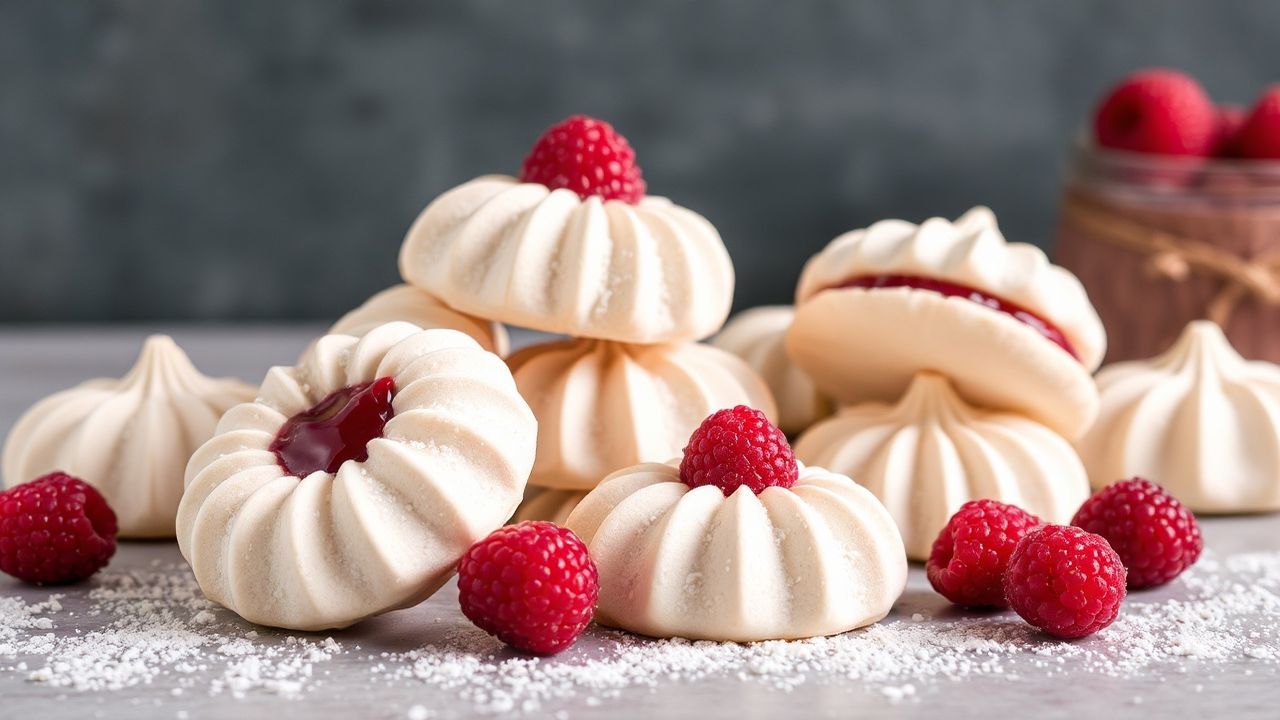
Almond meringue cookies feel like edible air: crisp edges, a light snap, and a gentle chew that melts into a nutty finish. Add a vibrant raspberry center and you get a dessert with real contrast—sweetness against bright tart fruit—rather than a one-note sugar cookie.
- Why Almond Meringue Cookies Taste “Restaurant-Smooth”
- Ingredients That Actually Affect the Texture
- Equipment and Setup (This Prevents Failures)
- Step-by-Step: Make Crisp Almond Meringue Shells
- 1) Whip egg whites to stiff, glossy peaks
- 2) Fold in almond flour without killing the air
- 3) Pipe uniform rounds
- 4) Rest until a dry skin forms
- 5) Bake low and slow
- 6) Cool fully before removing
- Raspberry Filling: Bright, Glossy, and Stable
- Assemble Without Losing the Crunch
- Storage and Freshness Rules
- Common Problems (and How to Fix Them Fast)
- Serving Ideas That Match the Flavor Profile
- Equipment & Technique Reference (So You Can Repeat Success)
- FAQ
At a Glance
- Low-temp baking dries meringues for crisp shells with minimal browning.
- Raspberry maceration boosts flavor and keeps the filling glossy.
- Assemble smart to protect crunch (fill close to serving).
- Humidity control matters as much as oven temperature.
Why Almond Meringue Cookies Taste “Restaurant-Smooth”
Classic meringues rely on whipped egg whites plus sugar for structure. When you add finely ground almonds, you bring nut aroma and a slightly richer interior texture.
That small change creates a layered bite: crisp surface first, then a tender center with nutty depth. You also get better flavor balance because almonds taste sweet but not candy-like.
Egg whites hold air bubbles stabilized by proteins. When you whip properly, the foam sets during drying, and the shell stays crisp after cooling.
If your foam collapses or your sugar doesn’t dissolve, the baked cookies turn grainy or weak. Then they soften faster because they hold less stable structure.
For background on the technique, read meringue. It helps you connect whipping changes to what you see in the finished shells.
The flavor pairing: almond + raspberry
Almond tastes naturally sweet and slightly toasty. Raspberry tastes tart and fruity, with acidity that cuts through meringue sweetness.
The result feels balanced, not cloying. When the filling carries both juice and body, each bite tastes fresh instead of flat.
When you macerate raspberries with a small amount of sugar, you pull out juices. Then the mixture thickens slightly as it rests, which helps the filling cling without instantly melting the shell.
If you want to study why raspberry flavor feels bright, review raspberry. The chemistry comes down to acidity plus aromatic compounds.
Ingredients That Actually Affect the Texture
Most almond meringue cookie problems come from one of three places: weak meringue, sandy sugar, or coarse nut particles. You can fix all three with ingredient choice and prep.
Start with room-temperature egg whites. Cold whites whip slower and form less reliable foam under the same conditions.
Use finely ground almonds (almond flour) that pass through a sieve if you see larger bits. Fine particles fold in evenly and produce a smoother shell surface.
Then keep everything clean. Even a small amount of fat can interfere with foam stability, which you can see in the way the mixture holds peaks.
For general structure and composition of egg proteins, see egg white. It gives useful context for why fat contamination matters.
Core cookie ingredients
Egg whites: 3 large eggs, room temperature, no yolk contamination. Yolks contain fats and emulsifiers that reduce foam stability.
Granulated sugar: 1 cup. Sugar dissolves during whipping and helps the foam set during drying. Don’t swap for powdered sugar unless you redesign the recipe.
Almond flour: 1/2 cup, finely ground and sifted. Almond flour adds flavor and a slight chew. Coarser pieces can create bumps.
Cream of tartar: 1/4 teaspoon. This acid improves foam stability and supports more consistent drying.
Vanilla and salt: 1 teaspoon vanilla extract plus a pinch of salt. Salt sharpens sweetness perception without turning the cookies salty.
Raspberry filling ingredients
Fresh raspberries: 1 cup, washed and patted dry. Water dilutes flavor and can thin the filling more than you want.
Powdered sugar: 2 tablespoons for maceration. Powder dissolves quickly and releases juice that forms a light syrup as it sits.
Optional garnish: mint leaves or edible flowers for a “pâtisserie” look.
For a broader look at fruit components, read fruit. It connects acids and sugars to flavor behavior.
Equipment and Setup (This Prevents Failures)
Before you whip anything, set up your workspace like a production line. Meringue batter waits for no one, and it starts losing stability as soon as you slow down.
Line two baking sheets with parchment or silicone mats. Use a piping bag fitted with a plain round tip for consistent rounds.
Also, keep your kitchen dry. Humidity slows drying and increases the odds of sticky, soft shells.
Since meringues dry through heat and airflow, your environment affects the final texture, not just the oven setting.
Oven temperature strategy
Almond meringue cookies usually bake at a low temperature (around 275°F / 135°C) to dry without heavy browning. Higher heat often cracks the outside before the inside fully dries.
Plan for gentle airflow. If your oven runs hot, reduce the baking time. If it runs cool, bake a little longer while watching the shells closely.
Step-by-Step: Make Crisp Almond Meringue Shells
Follow a two-phase approach. First you whip and dry for shells. Then you macerate and fill for the raspberry center.
Pay attention to timing. Small changes affect skin formation, drying speed, and final crispness.
1) Whip egg whites to stiff, glossy peaks
Use a spotless bowl and beaters. Start on medium speed, then add cream of tartar and a pinch of salt. Continue until foamy.
Now add sugar slowly, about 1 tablespoon at a time. This gives the sugar time to dissolve and stabilizes the foam.
Stop when the meringue forms stiff, glossy peaks and feels smooth between your fingers. If it feels gritty, whip longer.
This step controls most of the cookie’s crispness. A strong foam holds its shape through drying and cooling.
2) Fold in almond flour without killing the air
Fold sifted almond flour in gently using a spatula. Keep strokes light and limited. Overmixing collapses the foam and makes cookies dense.
Fold until the almond flour disappears and the batter looks uniform. Then add vanilla and fold once or twice more.
Work efficiently so the batter stays airy. If the batter rests too long, the foam structure softens.
That’s why the next step matters. Pipe right after mixing for best results.
3) Pipe uniform rounds
Pipe 1.5-inch rounds spaced about 1 inch apart. Hold the tip steady and keep the rounds level for even baking.
After piping, tap the tray firmly on the counter. This helps release trapped bubbles so shells don’t form tiny craters.
4) Rest until a dry skin forms
Let piped rounds rest for 60 minutes at room temperature. During this time, the surface dries and forms a thin skin.
That skin protects structure while baking and reduces spreading. In humid weather, the rest can take longer.
Check visually. A matte surface that doesn’t look wet usually signals the skin formed properly.
5) Bake low and slow
Preheat to 275°F (135°C). Bake about 25 minutes, switching trays halfway through for even drying.
You want shells that feel crisp on the outside. Keep the color pale because browning often signals too much heat.
6) Cool fully before removing
Cool shells on the trays. Hot meringues feel firm, but they continue drying as they cool.
If you remove them too early, they can crack or turn fragile. Once fully cool, peel them away carefully and store unfilled shells dry.
Raspberry Filling: Bright, Glossy, and Stable
The filling’s job stays simple. Add tart fruit flavor and a little moisture inside a dry shell, without flooding the cookie.
You can do this through maceration rather than heavy cooking. Maceration keeps the taste fresher and the texture lighter.
Cooked jam-like fillings also work, but maceration tends to keep the raspberry flavor brighter. It also reduces the risk of a thick filling that tastes overly sweet.
For a quick reference on fruit processing and preservation, see jam. It explains why cooked fruit thickens differently than macerated fruit.
How to macerate raspberries
In a small bowl, combine raspberries with powdered sugar. Gently mash a few berries to release juice, but leave some intact.
Let it sit 10–20 minutes. As it rests, juices seep out and form a light syrup around the fruit.
If you want a smoother filling, press through a sieve. If you prefer a rustic bite, keep seeds and skins.
Either way, aim for spoonable thickness, not watery liquid.
Texture check: avoid watery filling
When you spoon filling onto shells, it should hold its shape for a few seconds. If it runs like sauce, it’s too wet.
You can reduce water by patting berries drier next time. You can also rest the mixture longer so it thickens naturally as sugar dissolves.
Assemble Without Losing the Crunch
These cookies taste best when assembled close to serving. Once you add wet filling to crisp meringue, moisture transfers and softens edges.
Still, you can keep a good crunch window with the right filling amount and careful pairing.
Pair shells by size for even assembly. Then add filling to the flat underside of one shell.
Top with the matching shell and press lightly. Stop once the filling spreads slightly.
Sandwich method
Spoon or pipe a small dollop of raspberry filling onto the flat underside of one shell. Keep the layer thin so it won’t soak through.
Top with the matching shell and press just enough to seal. Avoid squeezing hard because it pushes filling toward the edges.
Timing strategy
Make shells ahead of time and fill the same day. If you must fill early, refrigerate in a sealed container.
Then bring assembled cookies to room temperature before serving. Room temperature improves raspberry flavor and reduces a cold, muted taste.
For plating ideas and how meringues hold structure in storage, see food preservation. It gives helpful context for moisture movement and shelf life.
[TIP]Expert Insight: For a more “pâtisserie” finish, pipe a slightly thicker ridge of meringue around the edge of each shell before filling. That ridge forms a barrier so the raspberry stays mostly contained, extending crispness.
Storage and Freshness Rules
Unfilled almond meringue shells store well because they stay dry. Filled cookies lose crunch sooner because raspberry juice hydrates the shell.
Use a practical schedule. Bake shells up to several days ahead, then assemble right before serving.
Keep filled cookies sealed. Airflow increases moisture exchange and softens the surface faster.
Also remember that refrigeration can change texture. It won’t ruin the cookies, but it can reduce the “snap” if you store too long.
Best storage practices
Unfilled shells: store in an airtight container at room temperature in a low-humidity spot. Add parchment sheets between layers.
Filled cookies: keep sealed in the refrigerator for up to 1–2 days. Bring to room temperature before eating for best flavor.
Common Problems (and How to Fix Them Fast)
Meringues look delicate, but failures usually follow predictable causes. When your almond meringue cookies crack, spread, or soften, you can diagnose quickly.
Use these checks during your next batch to correct the issue without wasting time.
Cracks during baking
Cracks often happen when heat sets the outside too quickly. Lower the oven by 5–10°F (about 3–6°C) next time or reduce bake time by 3–5 minutes.
Also check rest time. If the skin forms too late, steam escapes differently and can create fissures.
Sandy texture or gritty sugar
If you feel sugar grains, you didn’t whip long enough for full dissolution. Add sugar a bit slower and keep whipping until the mix turns smooth.
Try a finger test after you think it’s ready. Stop only when the mixture feels silky, not sparkly.
Soft cookies after cooling
Softness usually means the shells didn’t dry long enough or humidity interfered. Bake 5 more minutes at the same temperature, then cool fully again.
Also avoid assembling too early. Fill only when you’re ready to serve or shortly before.
Serving Ideas That Match the Flavor Profile
These almond meringue cookies deserve thoughtful presentation. Almond reads elegant, while raspberry adds color and brightness.
Keep styling simple. Let the contrast do the work.
Serve chilled filling with crisp shells for texture balance. That mix often tastes “restaurant-smooth” because each bite changes as it melts.
If you want extra aroma, add fresh herbs or light citrus on the side.
Tea service
Serve with chamomile, green tea, or a mild Earl Grey. The tart fruit and nutty sweetness balance gentle tannins.
Place cookies on a plate with fresh raspberries or mint leaves for color and a clean finish.
Platter pairing
Build a small dessert platter with vanilla bean ice cream, lemon curd, or fresh berries. Then let people mix textures: cold cream with crisp shell.
For a more dramatic look, dust shells lightly with powdered sugar right before serving.
Equipment & Technique Reference (So You Can Repeat Success)
If you make these often, you’ll see that meringue is repeatable. The method matters more than brand names or fancy gadgets.
Use the same piping tip size for uniform rounds and keep rest and bake timing consistent. Those choices create predictable results.
For additional context on classic dessert methods, see baking. It helps you connect heat transfer to texture changes.
Also, browse related recipes on-site for more almond meringue variations. For example: almond meringue.
If you want another internal option, use this related page for troubleshooting themes: raspberry desserts.
FAQ
How can I tell when the almond meringue is fully whipped?
Stop when peaks hold firmly and the mixture looks glossy. Then rub a small bit between your fingers. If it feels gritty, whip longer.
A smooth meringue folds better and dries more evenly, so the shells stay crisp longer.
Why do my meringue cookies soften even when I bake them?
Humidity and early filling cause most softening. Bake until dry, cool fully, and fill close to serving so moisture doesn’t migrate into shells.
Also store filled cookies sealed. Even small airflow increases moisture exchange.
Can I use frozen raspberries for the filling?
Yes, but thaw and drain them first. Extra liquid thins the filling and softens shells faster.
After draining, macerate with sugar the same way, then rest until spoonable.
What’s the best way to fill without cracking the shells?
Spoon small amounts and press gently. Avoid squeezing because meringue shells stay crisp but still fragile, especially at the edges.
Also let shells cool fully before assembly so they don’t soften from residual warmth.
Can I substitute another nut for almond flour?
You can try hazelnut flour or a finely ground nut blend. Flavor and texture will change because fats and particle size differ.
Almond pairs especially well with raspberry acidity, so almond flour gives the most classic balance.