

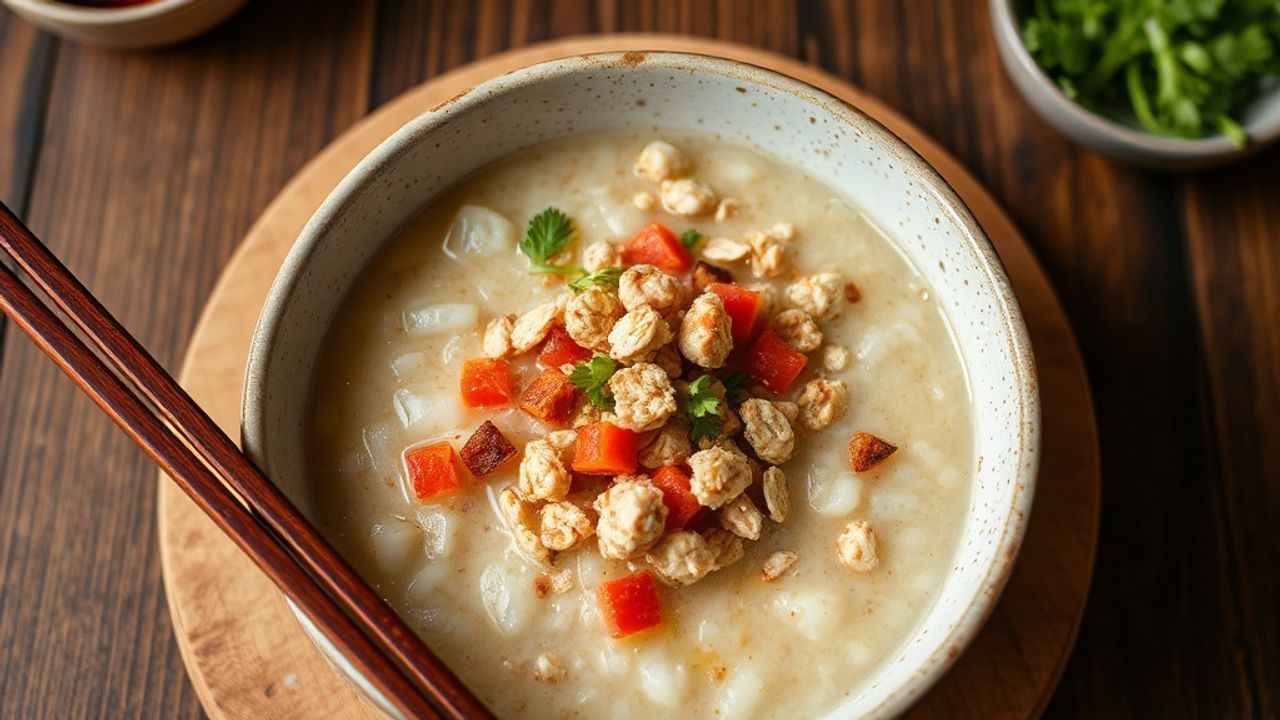
Savory congee stands at the crossroads of tradition and textural innovation in this recipe. This Savory Congee Delight with Crunchy Oatmeal Topping pairs the silky rice porridge with toasted oats to add nutty crunch and fiber to every spoonful.
- Overview: Why this Savory Congee works
- Prep and Cook time
- Yield and Difficulty
- Ingredients
- Instructions
- Tips for Success
- Serving Suggestions
- Nutritional Snapshot
- FAQ
- What is savory congee and how does the oatmeal topping change it?
- Can I make savory congee vegetarian or vegan?
- How do I store and reheat leftover congee?
- Are rolled oats the only option for the crunchy topping?
- What garnishes best complement the savory congee with oatmeal?
- Concluding Remarks
- Texture shift: Toasted oats add a crisp contrast to creamy congee.
- Nutrition boost: Rolled oats contribute fiber and whole-grain nutrients.
- Technique matters: Slow simmering and even toasting deliver the best mouthfeel.
- Versatility: The topping adapts to vegetarian or protein-forward versions.
Overview: Why this Savory Congee works
This savory congee recipe leverages low-and-slow cooking to break rice grains into a smooth porridge while introducing a toasted oatmeal layer for crunch. The contrast keeps each spoonful balanced and appealing for both breakfast and main meals.
Rice porridge like congee has deep cultural roots and practical nutrition; see the historical context on congee (rice porridge). Using toasted oats borrows from whole-grain cooking practices described on oatmeal entries.
Prep and Cook time
Plan about 15 minutes of active prep and approximately 60–80 minutes of gentle simmering for texture development. The slow cook softens jasmine or short-grain rice until it yields a creamy body that carries the topping without collapsing.
Set a timer for periodic stirring to prevent sticking and to check viscosity. For reference on rice varieties and characteristics, consult jasmine rice details.
Yield and Difficulty
This batch yields four generous bowls, suitable for family meals or meal prep. The technique rates as medium difficulty: it requires attention during simmering and careful toasting of oats for an even crunch.
Adjust the recipe scale and broth ratio to change thickness from porridge-like to soupier textures. For fundamentals on rice cooking science, see general notes in rice resources.
Ingredients
Ingredient selection shapes both flavor and mouthfeel for savory congee. Key players are jasmine or short-grain rice, a clear broth, aromatics, toasted oats, and simple garnishes like scallions and cilantro.
Choose low-sodium broth to control salt levels and use toasted sesame oil sparingly for aroma; learn about oil profiles at the sesame oil reference. Below are the measured ingredients used in testing.
- 1 cup jasmine rice, rinsed until water runs clear
- 8 cups low-sodium chicken broth or vegetable broth for vegetarian option
- 1-inch piece fresh ginger, thinly sliced
- 2 cloves garlic, crushed
- Salt, to taste (about 1 teaspoon)
- 1 tablespoon toasted sesame oil
- 1 cup rolled oats (for the crunchy topping)
- 2 tablespoons unsalted butter or neutral vegetable oil
- 1 teaspoon soy sauce, low sodium
- 4 scallions, thinly sliced (reserve some for garnish)
- 1/4 cup roasted peanuts, roughly chopped (optional)
- Fresh cilantro leaves, for garnish
- Freshly ground white pepper, to taste
Instructions
Follow a three-stage workflow: prepare the congee base, craft the crunchy oatmeal topping, and assemble the bowl. Each stage focuses on temperature control and timing to protect texture.
Keep the heat low for simmering and medium for toasting; this separation prevents the oats from burning while the rice converts to a velvety porridge. The ordered steps below reflect a reproducible process.
- Prepare the rice base: In a large heavy-bottomed pot, combine rinsed jasmine rice, chicken or vegetable broth, sliced ginger, and crushed garlic. Bring to a boil over medium-high heat.
- Simmer to creamy perfection: Once boiling, reduce heat to low, cover partially, and let simmer gently, stirring occasionally to prevent sticking. Cook for approximately 1 hour or until the rice grains break down and the texture turns velvety.
- Season the congee: Remove ginger and garlic pieces. Stir in salt and toasted sesame oil, adjusting seasoning to your preference. Keep warm on the lowest heat setting.
- Create the crunchy oatmeal topping: While the congee simmers, melt unsalted butter in a skillet over medium heat. Add rolled oats and sauté until golden brown and fragrant, about 6–8 minutes, stirring frequently for even toasting.
- Add depth to the topping: Splash in soy sauce and stir to coat the oats evenly. Remove from heat and mix in chopped scallions and roasted peanuts if using; the savory crunch complements the creamy base beautifully.
- Assemble and serve: Ladle warm congee into shallow bowls, sprinkle generously with the crunchy oatmeal topping, and garnish with fresh cilantro, extra scallions, and a dash of white pepper.
Toasting Oats Technique
Toast oats over medium heat in a dry or lightly oiled pan; avoid high heat because oats char quickly. Stir constantly and watch for a uniform golden-brown color and nutty aroma as indicators of doneness.
For added complexity, finish with a touch of soy sauce or a splash of toasted sesame oil off-heat to avoid steaming the oats. Cool the toasted oats briefly before mixing with wet garnishes to preserve crunch.
Tips for Success
Temperature control and patience are the main drivers of consistently smooth congee. Maintain a gentle simmer and resist the urge to crank heat when the porridge thickens; incremental additions of broth restore silkiness.
Use a heavy-bottomed pot to reduce hotspots and stir every 10–15 minutes to free any sticking grains. Short-grain rice yields a naturally creamier congee, while jasmine adds a delicate perfume.
Customize toppings to your palate: replace peanuts with toasted sesame seeds, fried shallots, or crisped garlic. For protein, add shredded chicken, soft-boiled egg, or pan-seared mushrooms to maintain balance.
Serving Suggestions
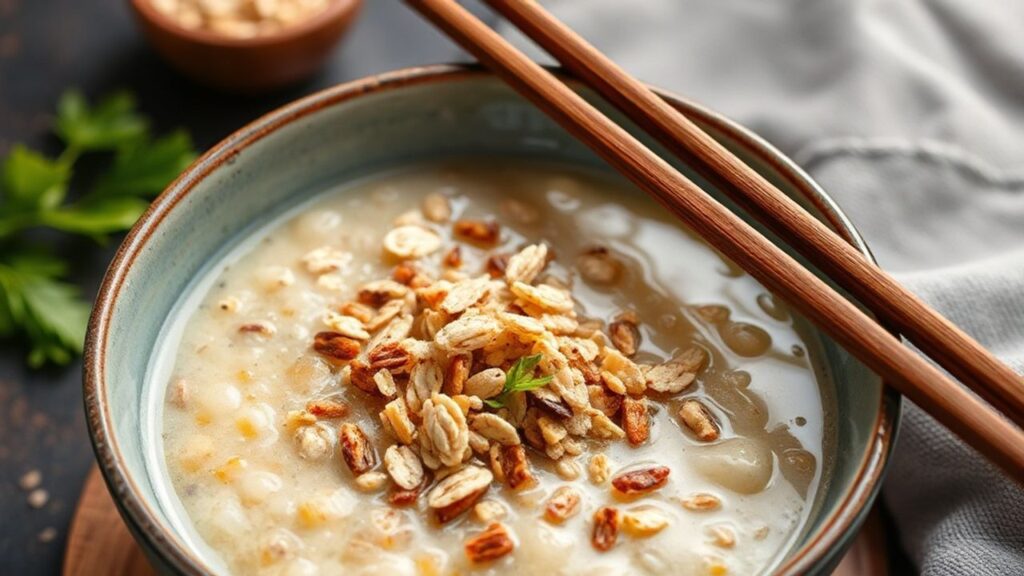
Present your savory congee in shallow bowls so the toasted oats sit prominently on the surface. The visual contrast between the glossy porridge and crunchy topping encourages diners to experience textures together.
Offer condiments at the table, such as chili oil, pickled vegetables, or a wedge of citrus, to let guests personalize heat and acidity. For more rice-focused recipes, see internal guides like Ultimate Rice Recipes and Rice Basics and Techniques.
Nutritional Snapshot
This version provides a balanced macro profile: moderate carbohydrates from rice and oats, modest protein from broth and optional nuts, and controlled fat from butter or oil. Rolling oats add soluble fiber and slow-release carbohydrates.
Use low-sodium broth and measured soy sauce to control sodium intake. Adjust portion sizes and add lean proteins to increase satiety and micronutrient density.
| Nutrient | Per serving |
|---|---|
| Calories | 280 kcal |
| Protein | 8 g |
| Carbohydrates | 45 g |
| Fat | 6 g |
FAQ
What is savory congee and how does the oatmeal topping change it?
Savory congee is a rice porridge cooked until grains break down into a smooth, comforting base. The crunchy oatmeal topping introduces a toasted, nutty element that contrasts the congee’s silkiness and adds whole-grain fiber.
Can I make savory congee vegetarian or vegan?
Yes. Substitute vegetable broth for chicken broth and use olive oil or a plant-based spread instead of butter. Add tofu, mushrooms, or sautéed legumes to boost protein while keeping the oatmeal topping savory.
How do I store and reheat leftover congee?
Refrigerate cooled congee in airtight containers for up to 3 days. Reheat gently on the stovetop, adding a splash of broth or water and stirring to recover the silky texture.
Are rolled oats the only option for the crunchy topping?
Rolled oats toast reliably and have a pleasant mouthfeel, but you can mix in quinoa flakes, buckwheat groats, or toasted seeds for different textures. Ensure any substitute toasts evenly to avoid bitterness.
What garnishes best complement the savory congee with oatmeal?
Classic garnishes include scallions, cilantro, white pepper, soft-boiled egg, and a drizzle of chili oil. Acidic pickles or a squeeze of lime brighten the bowl and cut through the starchiness.
Concluding Remarks
When savory congee meets a crunchy oatmeal topping, the result is a layered, nourishing bowl that balances comfort with texture. The method rewards patience: slow-simmered rice and carefully toasted oats produce a repeatable, high-value dish.
Experiment with protein additions and topping variations while keeping the core technique intact. This adaptation modernizes a long-standing staple without sacrificing its simple, restorative character.
Explore more variations by returning to the Ultimate Rice Recipes guide or the Rice Basics and Techniques primer for technique-focused reads.
See also: savory congee